
Fortinet white logo
Fortinet white logo

SPA

SPA

Secure private access (SPA) secures FortiSASE remote user access to private company-hosted applications that a FortiGate next-generation firewall (NGFW) protects.

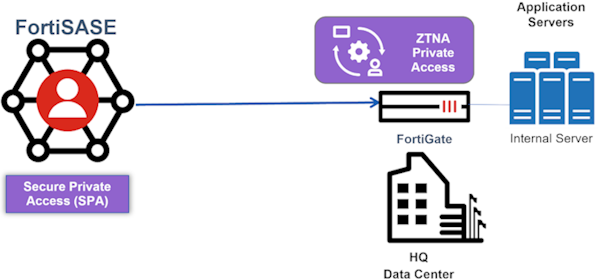
SPA using zero trust network access (ZTNA) secures private TCP-based applications, namely, leveraging FortiSASE integration with the FortiGate ZTNA access proxy. This use case offers a direct (shortest) path to private resources and per-session user authentication thus offering greater performance and security.
For securing private TCP-based and UDP-based applications, FortiSASE supports SPA using SD-WAN or SPA using an NGFW converted to a standalone FortiSASE SPA hub.
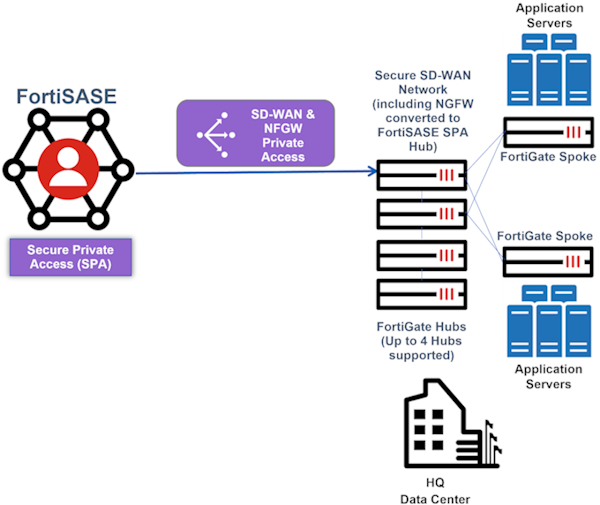
FortiSASE security points of presence and the organization’s FortiGate hubs form a traditional hub-and-spoke topology that supports the Fortinet autodiscovery VPN (ADVPN) configuration. ADVPN is an IPsec technology that allows a traditional hub-and-spoke VPN’s spokes to establish dynamic, on-demand, direct tunnels, known as shortcut tunnels, between each other to avoid routing through the topology's hub device.

SPA

SPA

Secure private access (SPA) secures FortiSASE remote user access to private company-hosted applications that a FortiGate next-generation firewall (NGFW) protects.

SPA using zero trust network access (ZTNA) secures private TCP-based applications, namely, leveraging FortiSASE integration with the FortiGate ZTNA access proxy. This use case offers a direct (shortest) path to private resources and per-session user authentication thus offering greater performance and security.

For securing private TCP-based and UDP-based applications, FortiSASE supports SPA using SD-WAN or SPA using an NGFW converted to a standalone FortiSASE SPA hub.

FortiSASE security points of presence and the organization’s FortiGate hubs form a traditional hub-and-spoke topology that supports the Fortinet autodiscovery VPN (ADVPN) configuration. ADVPN is an IPsec technology that allows a traditional hub-and-spoke VPN’s spokes to establish dynamic, on-demand, direct tunnels, known as shortcut tunnels, between each other to avoid routing through the topology's hub device.